By GWT Team / Updated: Feb 11, 2026 / 10 min read
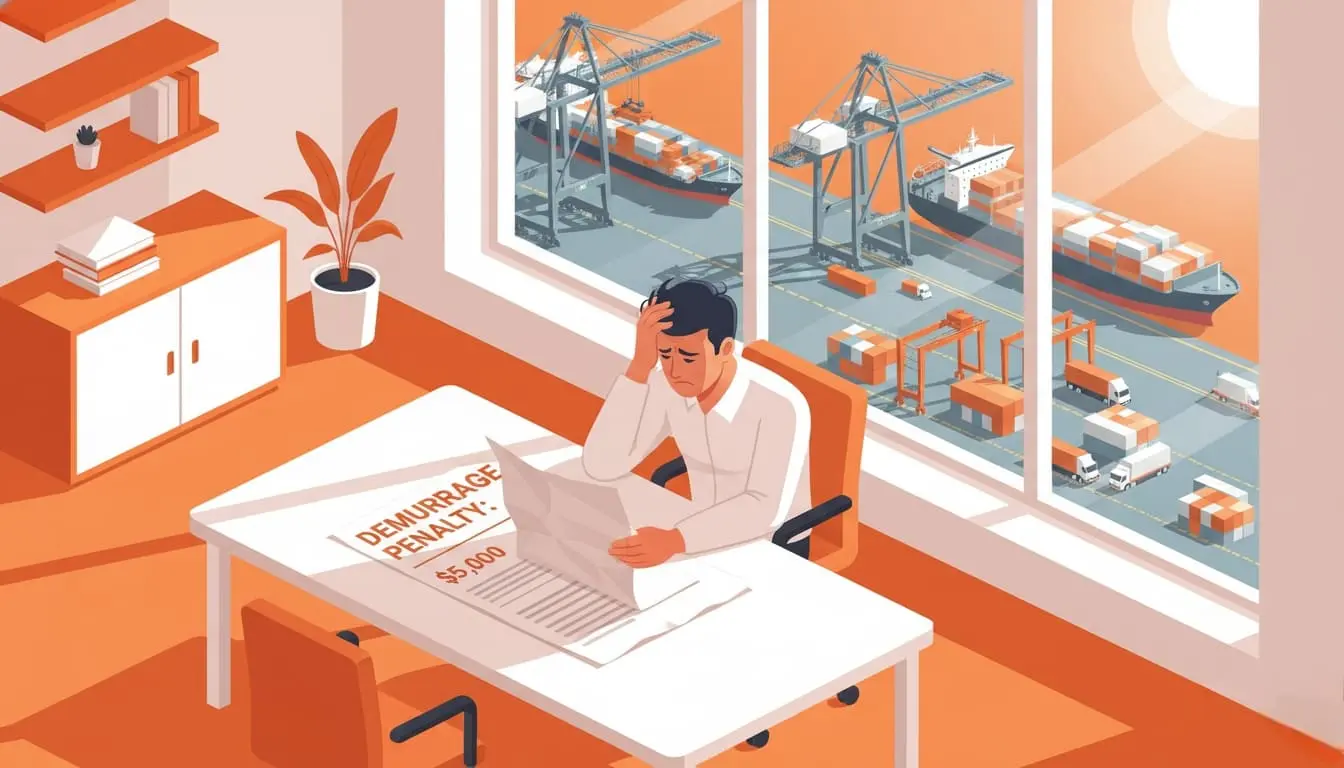
Imagine your cargo finally arrives at the port, but instead of celebrating, you get a bill for thousands of dollars. This is Demurrage.
It gives importers and exporters a huge headache. It eats up your profits and causes arguments between buyers and sellers. Many people lose money simply because they don’t understand the rules or don’t know how to stop the clock.
In this article, we will explain exactly what demurrage is. We will also show you how to avoid it and what to do if you get charged.
Chapter 1: What is Demurrage?
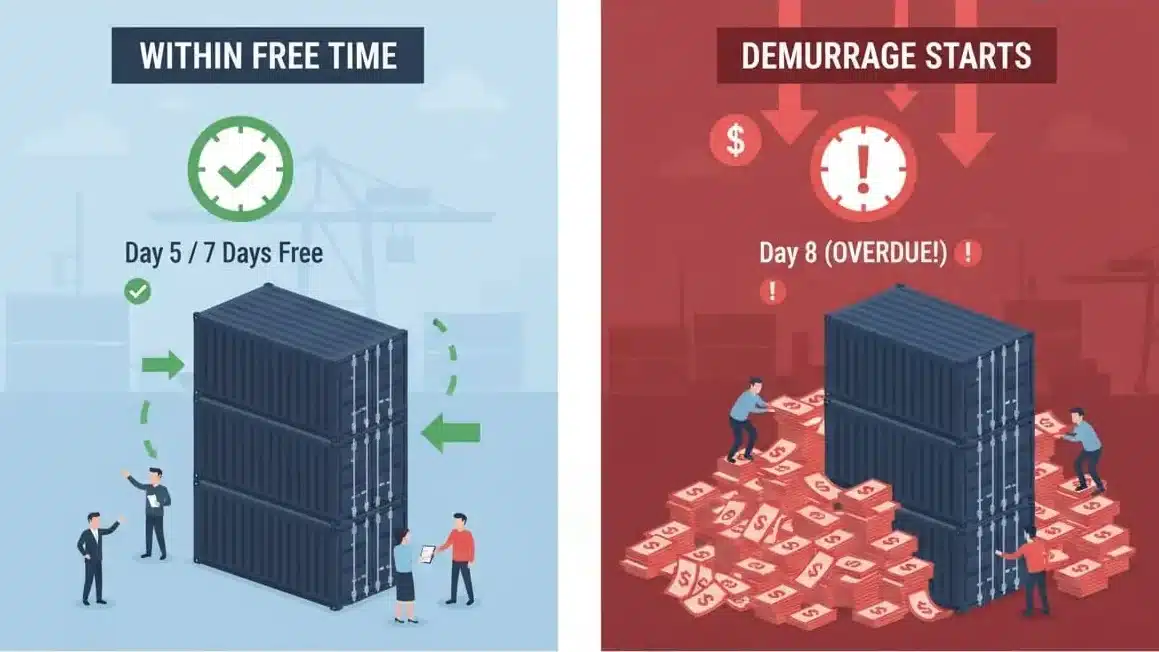
Demurrage is a daily penalty fee charged by the shipping line when your container stays inside the terminal longer than the allowed free time.
The clock starts when the container is discharged from the vessel and sits in the terminal, and it stops when the full box gates out.
Before demurrage starts, you usually get a few “free days”.
What is Free Time?
The grace period the carrier gives you to clear customs and pick up the container without paying any penalty.
Why does it exist?
To give you reasonable time for customs clearance and trucking arrangement. Usually, standard free time is about 5 to 7 days after the container is unloaded from the ship.
Note: Free time varies significantly by region. Do not assume 7 days is the standard everywhere. (We explain the critical differences between Europe, Asia, and Brazil in Chapter 2).
Demurrage vs. Detention vs. Storage
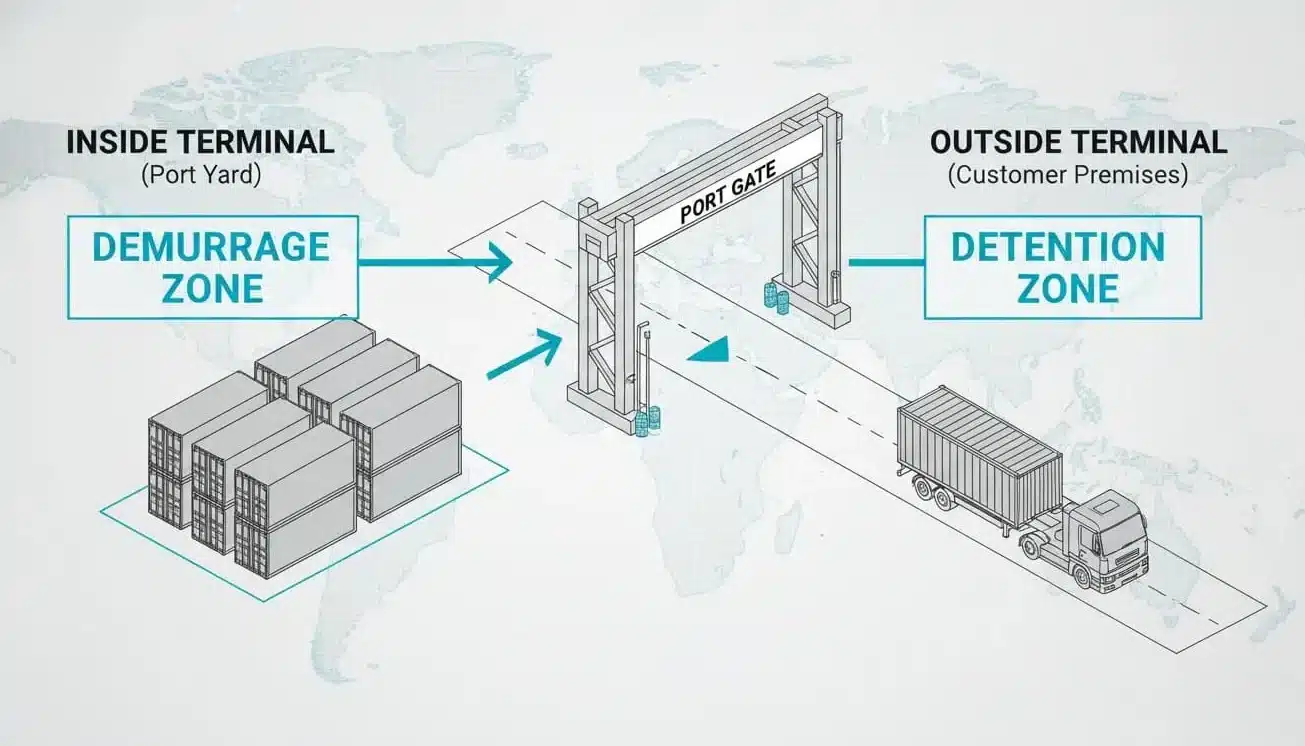
These three charges are often mixed up, but they cover different locations and responsibilities.
| Charge Type | Where Is the Container? | Who Charges It? | When Does the Clock Start? | When Does It Stop? | Key Action |
| Demurrage | Inside the terminal (yard) as a full box | Shipping line | After free time, from discharge (imports) or gate‑in full (exports) | When full container gates out | Pick up the full box |
| Detention | Outside the terminal (on truck, at your warehouse) | Shipping line | When full box gates out of terminal | When empty container is gated in / returned | Return the empty box |
| Storage | On terminal land (yard/warehouse), full or empty | Terminal / port | After storage free time expires | When container leaves the stack / is moved out | Free up port space |
Three key points:
- Demurrage = you are using the shipping line’s container inside the terminal beyond free time.
- Detention = you are keeping the shipping line’s container outside the terminal beyond free time.
- Storage = you are occupying the terminal’s land/yard, regardless of whose container it is.
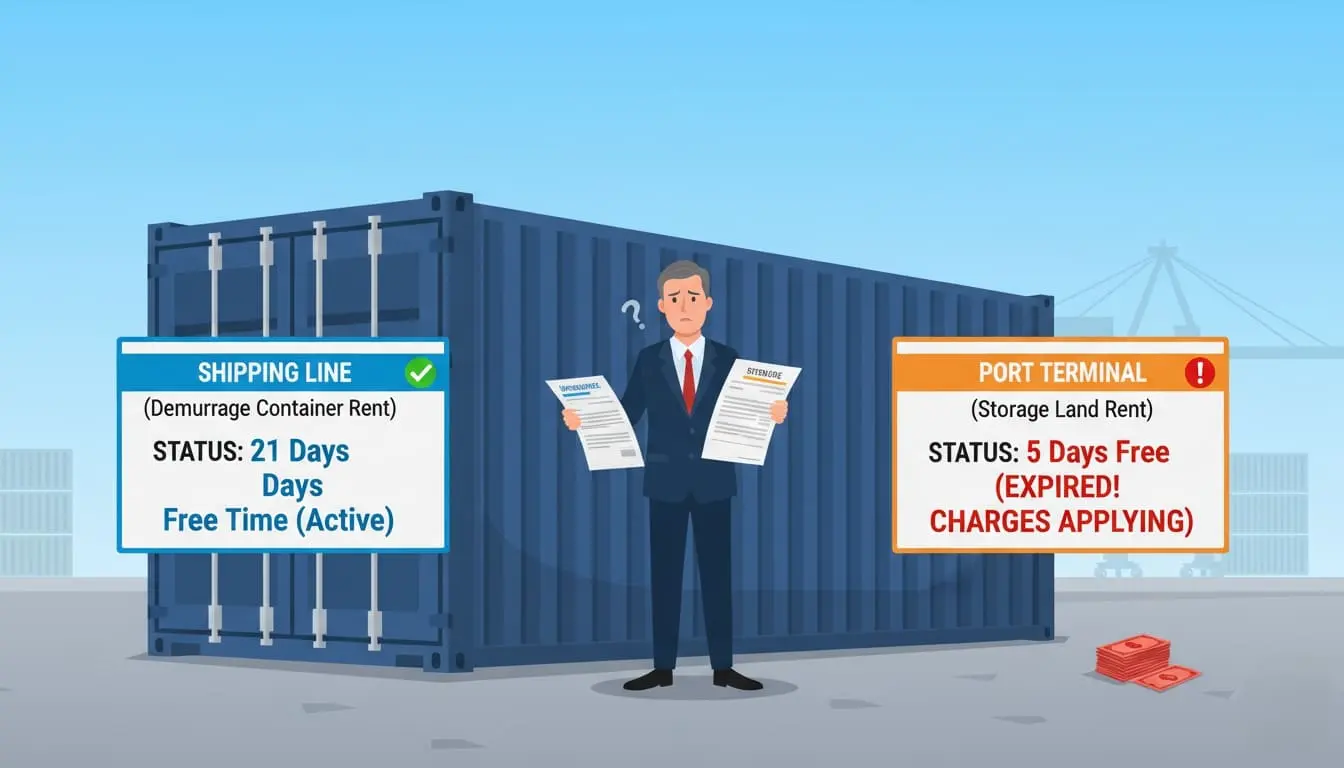
Many importers make a costly mistake: They think “Free Demurrage” means “Free Everything.”
It does not.
Demurrage is the penalty for using the shipping line’s container.
Storage is the rent for using the port’s land.
Even if we secure 21 days of Free Demurrage for you, the Port Terminal might only give you 5 days of Free Storage.
These are separate clocks.
They are billed separately. And they often run at the same time.
A good forwarder will always look at demurrage + detention + storage together, not just “free days” in the rate sheet.
Chapter 2: How is it Calculated?
Once free time ends, you pay for every single day the container sits there. This includes weekends and holidays!
Free Time and Calendar Days
Demurrage free time is usually given in calendar days, not working days.
If your free time ends on Friday, and you only pick up the container on Monday, you may be charged for Saturday + Sunday + Monday as 3 days of demurrage.
Always confirm:
- Number of free days
- Whether they are calendar or working days
- Whether weekends/holidays are charged
Global Variations: Don’t Assume 7 Days!
Many importers mistakenly assume “7 days” is the standard worldwide. It is not. Geography determines your grace period:
- Europe: Extremely strict. Ports usually allow only 3–5 days of free time. If you plan for 7 days here, you will pay fines.
- Asia: More generous. Many ports offer 7–14 days, but penalties increase sharply the moment that period ends.
- USA: Terms are complex. While influenced by FMC guidelines, the specific days are set individually by each carrier and terminal.
- Middle East/Africa: Due to slower customs processes, you might find longer free time periods, but rates are high.
- Brazil: Typically 5-7 days for Demurrage, but only 3-5 days for Terminal Storage.
Never rely on “standard” rules. For every shipment, you must check the specific “Free Time” clause on your Bill of Lading. That is the only number that matters.
Progressive Daily Rates
The rate is usually “progressive,” meaning it gets more expensive the longer you wait.
Overdue fees are found by multiplying the daily fee by the number of days the shipment is late.
Transportation lines may charge from $25 to $75 daily for a standard 20-foot container and from $50 to $150 for a 40-foot container, based on the shipment’s destination, the carrier and market conditions.
Typical patterns:
- Lower rate for the first few days after free time
- Higher rate for the next block of days
- Very high rate for long overstays (to force you to move the box)
Rates depend on:
- Port
- Carrier
- Container type (20’ vs 40’, dry vs reefer vs special)
- Trade lane and market conditions
Standard dry containers usually result in less demurrage than specialized containers, like reefers, open-top containers or flat racks, as they are more difficult to get and cost more to replace.
Note: If you are shipping a Refrigerated Container (Reefer), these fees are much higher. They can easily double the standard rate.
Example: Standard 20’ Dry Container
Let’s walk through a simple scenario.
- Container type: 20’ dry
- Free time: 7 calendar days
- Tariff (after free time): Days 1–5: USD 80 per day
Days 6–10: USD 150 per day
Day 11+: USD 250+ per day
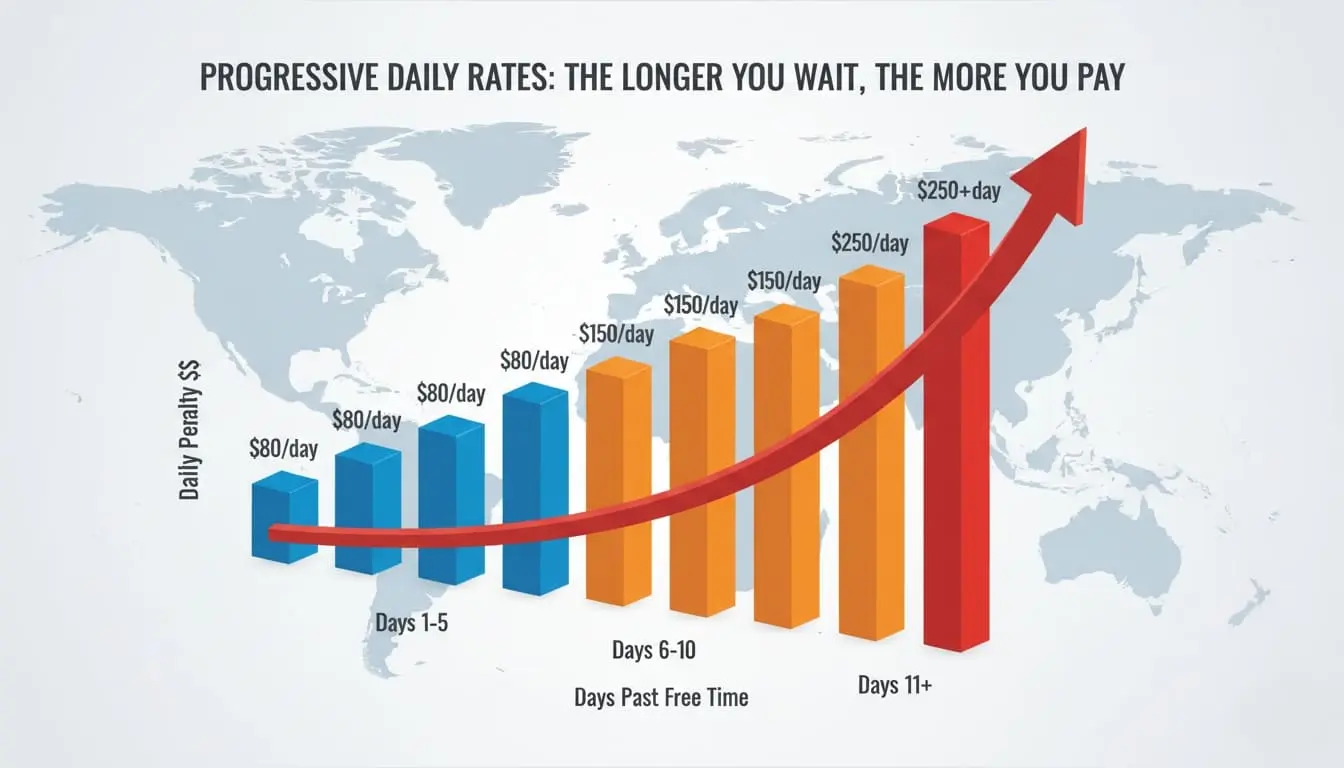
Your container is discharged on Day 0, and you only pick it up on Day 15.
- Free time: Days 1–7 → no demurrage
- Chargeable days: Days 8–15 → 8 days total
Breakdown:
- Days 8–12 (5 days at USD 80): 5 × 80 = USD 400
- Days 13–15 (3 days at USD 150): 3 × 150 = USD 450
- Total demurrage: USD 400 + USD 450 = USD 850
If this had been a 40’ container, each daily rate might be 1.5–2× higher. If it was a reefer, you could easily see double the dry container rates.
Don’t Forget Storage Charges
Now add storage to the picture:
- Terminal storage free time: 5 days
- Storage rate: Days 1–5: free
Days 6–10: USD 50 per day
Day 11+: USD 100 per day
In the same scenario (pick-up on Day 15):
- Storage chargeable days: Days 6–15 → 10 days total
- Days 6–10 (5 days at USD 50): 5 × 50 = USD 250
- Days 11–15 (5 days at USD 100): 5 × 100 = USD 500
- Total storage: USD 750
So your total “delay cost” for this one 20’ container is:
- Demurrage: USD 850
- Storage: USD 750
- Grand total: USD 1,600
This is why many people feel, “My ocean freight cost was only $1,200, but the port delays and storage added up to more than the freight itself.”
Once you see the full formula, you’ll understand why it’s crucial to manage timelines and free time in advance, rather than regretting it when the bill arrives.
Chapter 3: Who Pays for Demurrage?
In most cases, the Consignee (the importer) is responsible for paying demurrage. It is your cargo, so it is your responsibility to clear customs and pick it up on time.
Special Situations (Shipper’s Fault)
Sometimes, the delay is clearly the Shipper’s fault (e.g., they sent the wrong documents or delayed the Telex Release).
The “Pay First, Claim Later”: Even if it is the Shipper’s fault, the shipping line will not release the cargo until the bill is paid. They do not care about your dispute with the factory.
Usually, the Consignee must pay the demurrage to the shipping line first to get the goods, and then ask the Shipper for a refund or deduct it from the next payment.
The Role of the Forwarder
Often, the freight forwarder at the destination has to pay this bill upfront to the carrier to get the goods released quickly. They will then invoice the customer. If the customer refuses to pay, the forwarder is stuck with the loss.
Tip: How to Protect Yourself in the Contract
Many disputes happen because the Sales Contract or Proforma Invoice (PI) isn’t clear about who pays for delays.
We recommend adding a simple clause to your Purchase Orders (PO) or Contracts to avoid arguments:
“Demurrage, Detention, and Storage charges at the port of destination are for the Buyer’s account, unless such charges are caused by the Seller’s negligence (e.g., late or incorrect documentation).”
This clause clearly defines that if the factory messes up the paperwork, they pay the bill. Having this in writing makes it much easier to claim a refund later.
Chapter 4: Why Does Demurrage Happen?
Demurrage hits when you can’t pick up your cargo before free time runs out. We’ve seen every scenario. Here are the 5 most common traps that burn clients:
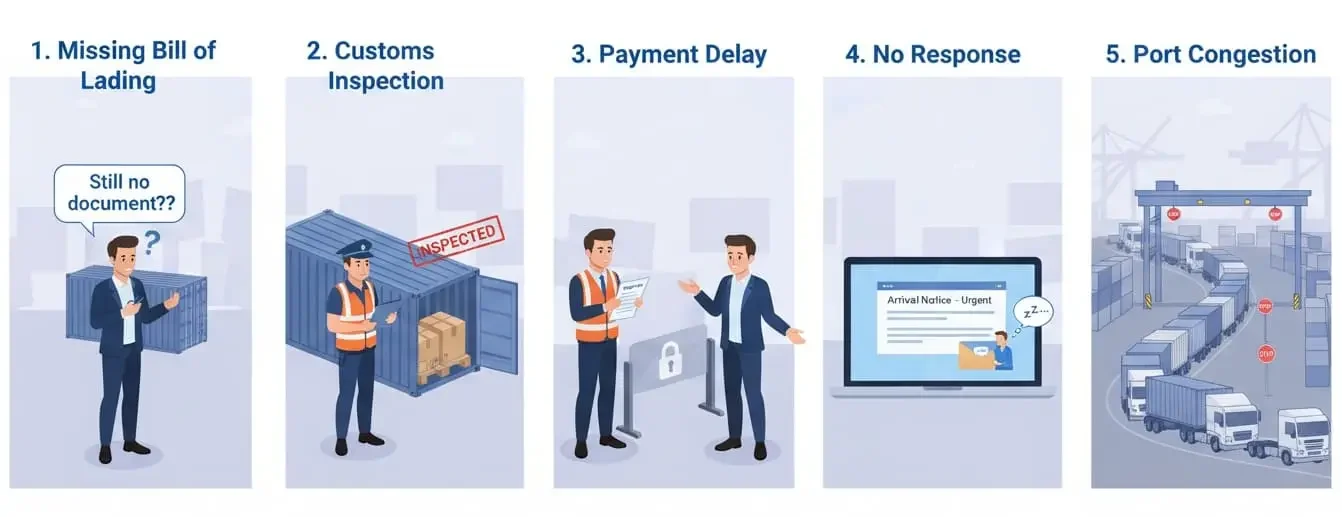
- No Bill of Lading (B/L) Release: Your vessel docks, but the factory hasn’t released the B/L. Originals stuck in courier mail, or Commercial Invoice has a HS code mismatch. The container collects dust while you track DHL. One missing endorsement cost a client $2,800 last month.
- Customs Inspection: Customs pulls your container for an exam. They demand technical datasheets, compliance certificates, or extra origin docs you weren’t expecting. This is a very common scenario in countries like Brazil or Mexico. Until customs gives the green light, the clock keeps ticking on your free time, and you cannot touch the cargo.
We have seen cases where a routine exam turned into a $10,000 bill because the container wasn’t moved to a cheaper bonded warehouse during the wait.
- Payment Delays: If the shipper (factory) hasn’t received your final balance payment, they will refuse to surrender the B/L or Telex Release. The shipping line won’t release the cargo to you until the shipper says so, leaving your goods stuck at the terminal accruing demurrage until you settle the debt..
- Lost Contact: It sounds simple, but it happens constantly. Sometimes, the “Notify Party” listed on the bill simply doesn’t answer the phone or check their email. The Arrival Notice sits unread in a spam folder. By the time you realize the ship has docked, your free time has already expired. You end up paying for silence.
- Port Congestion: Sometimes, your paperwork is perfect, but the port is paralyzed. During peak seasons, you might struggle to find a truck chassis or secure a gate appointment. Even if you want to pick up the box, you physically cannot get in before penalty fees kick in.
- Force Majeure: What if a port strike, typhoon, or ice storm forces the terminal to close its gates? Logic says you shouldn’t pay, but the shipping line’s billing system is automated. It often doesn’t know the gate is closed and bills you automatically anyway. We recently saw an automated system charge over $4,000 in demurrage during a major rail ramp closure. The computer didn’t know the gate was locked. This is why you need a partner who knows how to dispute these charges and prove that the terminal was inaccessible. (We will explain how to fight this in Chapter 6).
Chapter 5: How to Avoid Demurrage (And How We Help)
The best way to handle demurrage is to stop it before it starts. This is where a good partner in China makes a huge difference.
1. Smart Scheduling in China
We monitor the “Cut-off Dates” closely. We coordinate with factories to ensure cargo doesn’t arrive at the port too early.
If cargo sits at the origin port too long before the ship leaves, it can eat into your free time or cause storage fees. We prevent this.
2. Document Pre-Check (Crucial for Brazil/Latam)
Nothing kills free time faster than bad paperwork. We check your Commercial Invoice and Packing List before the vessel sails, catching errors that would otherwise delay your clearance by weeks.
- For destinations with strict customs (like Brazil or Mexico), catching a typo in China saves you weeks of delay at the destination.
- But beyond typos, we look for hidden compliance triggers like undeclared fumigants in wood packaging. We have seen simple oversights here cause delays of up to 30 days and bills exceeding $15,000. We audit early to prevent this “Fumigation Trap” or move cargo to a Bonded Warehouse if a delay is unavoidable.
3. Request Extended Free Time
As a Tier-1 forwarder, we can negotiate with shipping lines. Instead of the standard 7 days, we can often secure 14 to 21 days of combined free time for our clients. This gives you a safety buffer.
4. Leverage Our Local Network (One-Stop Solution)
In logistics, “who you know” often matters as much as “what you know.”
Our long-standing relationships with terminal operators and local trucking fleets allow us to address problems quickly. When the port is congested, these connections help us find solutions, like securing a scarce chassis, that others might miss.
From the warehouse in China to the final delivery truck, we provide a one-stop solution. This integrated approach closes the gaps where demurrage usually happens.
Chapter 6: What If You’re Already Charged?
Sometimes, delays are unavoidable. Here is what you can do.
The Golden Rule: Never Pay Immediately
Demurrage bills arrive fast, but you don’t have to pay them fast. Here’s your step-by-step playbook.
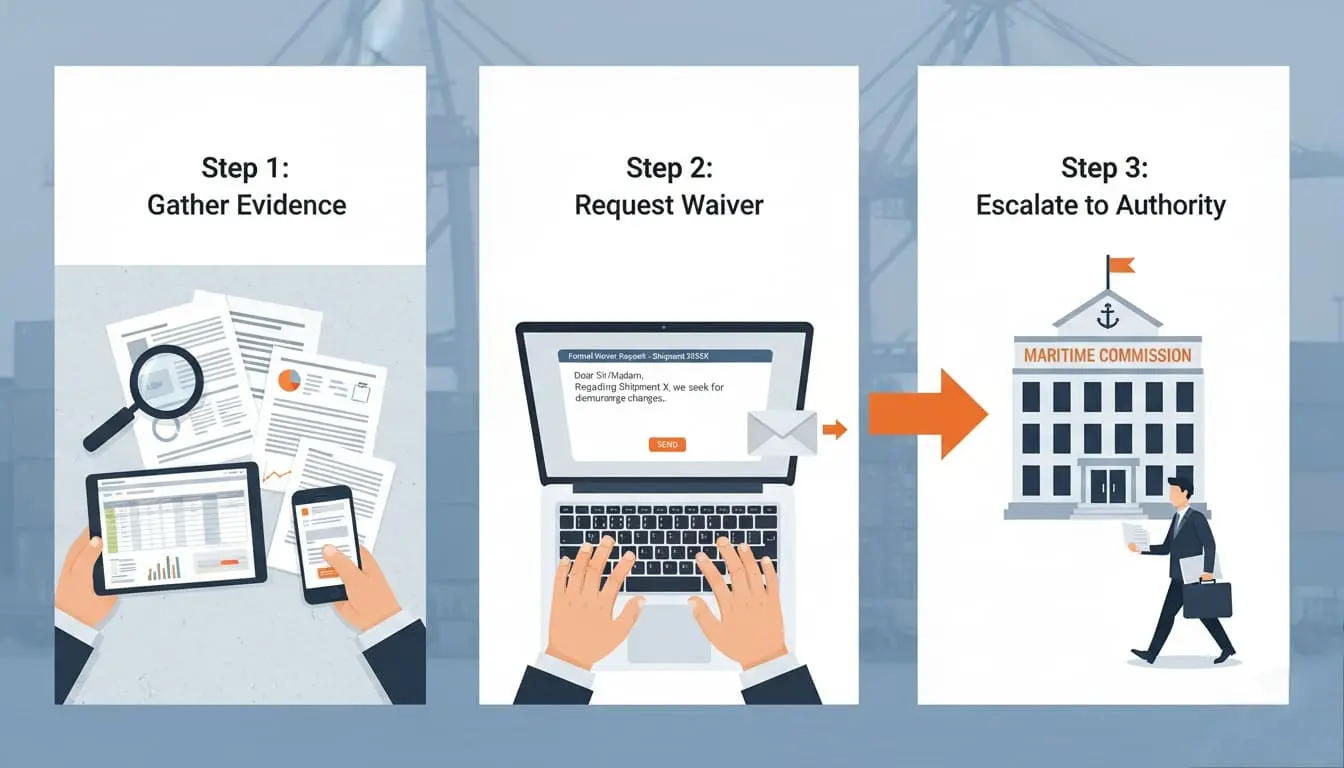
Step 1: Pause and Gather Evidence (24 Hours)
Don’t click “pay now”. Request a detailed breakdown first:
- Ask for: exact calculation (free time start/end dates + daily rates applied)
- Screenshot all timestamps: vessel discharge, arrival notice, gate-out attempts
- Screenshot all timestamps: vessel discharge, arrival notice, gate-out attempts
Tip: Take photos of gate-out receipts showing “terminal closed” or “no chassis available”.
Step 2: Request Waiver or Reduction (Within 7-14 Days)
Most carriers offer some flexibility if you act fast:
For Force Majeure (Strikes, Weather, Terminal Closure):
Subject: Demurrage Dispute – Invoice [XXXXX] (BL: [XXXX])
Dear [Carrier Representative],
We respectfully request a review and full waiver of demurrage charges totaling USD [XXX] under Bill of Lading [XXXX].
The container was discharged on [date], and the charged period covers [date range]. However, during this period, the terminal was physically inaccessible due to [specific event: Santos port strike / severe ice storm / official gate closure].
As confirmed by the attached terminal notices and public announcements, truck gate operations were suspended, and no pick-up appointments were available.
Under your tariff’s Force Majeure provision, demurrage serves as an incentive for cargo movement. When the terminal is closed and cargo cannot be retrieved, such charges no longer function as an incentive and therefore become punitive in nature.
Supporting documentation is attached, including:
• Official terminal closure notice
• Appointment system screenshots
• Gate-out denial records
Given that this delay was entirely beyond our control, we kindly request a full waiver of the assessed demurrage.
We appreciate your review and look forward to your confirmation.
Best regards,
[Name]
[Company]
We handle this for clients: Our team drafts the letter, attaches evidence, and follows up until resolved.
For Negotiable Delays: Offer to pay 50% if you can prove you acted reasonably. Reference past good business: “We’ve shipped 50 TEU this year without issues”
Step 3: Escalate If Denied (30 Days Window)
You might have heard about recent legal battles in the U.S. regarding unfair shipping charges (like the famous Evergreen detention case).
While that case was about returning empty containers, the core legal principle established by the FMC (Federal Maritime Commission) applies to Demurrage as well.
FMC rules state demurrage is only legal as an incentive to pick up cargo. If gates were closed (weekends/holidays/system outage), it’s a penalty, not an incentive and often waivable.
Under current FMC guidelines, charging Demurrage when a terminal is physically inaccessible is often considered unreasonable. If a shipping line bills you for days when their gates were closed, you have grounds to dispute it.
File FMC Complaint (free, online):
- Evidence needed: Proof terminal was inaccessible during charged days
- High for clear force majeure cases.
- Other Regions: Escalate to local maritime authority or arbitration (contract clause).
→ Start Your Official Dispute Process Here
80% of demurrage disputes are winnable with proper evidence and persistence. A China-based forwarder with experience fighting these battles gives you the edge.
Conclusion
Demurrage is a frustrating part of international shipping, but it is not inevitable.
By understanding the rules and having a proactive team in China, you can keep your costs down. Don’t let these “parking tickets” eat your profit.
Plan ahead, check your documents, and always ask for extra free time before you book. If you need help securing those extra free days, just let us know.
FAQ
What is demurrage in simple terms?
Think of demurrage as a “late fee” for a rental car that you haven’t picked up yet. The shipping line rents you a container.
If you leave that container sitting inside the port terminal after your “free days” run out, the shipping line charges you a daily penalty.
It’s their way of forcing you to clear out space so they can bring in new cargo.
How much does demurrage cost per day? (2026 Update)
It varies by carrier and port, but it is getting more expensive.
Standard Dry Container (20′): Typically $75 – $200 per day for the first few days, escalating to $300+ per day after a week.
Reefer (Refrigerated) Container: Much higher, often starting at $350 – $500 per day.
Major carriers like Maersk and CMA CGM have recently adjusted tariffs in many regions. Expect progressive rates where the daily fee doubles after Day 10.
Always check the “D&D Tariff” on the carrier’s website for your specific destination. The rate on Day 15 is often 3x the rate on Day 1.
What is the difference between Demurrage, Detention, and Storage?
It comes down to location and who gets paid:
Demurrage charges you for the time the full container sits inside the terminal. The fee stops accumulating the moment you pick up the cargo and drive out of the gate.
Detention charges you for the time you keep the container outside the port (e.g., while unloading at your warehouse). The fee only stops when you return the empty container to the shipping line.
Storage is simply the “land rent” paid to the terminal operator, which usually runs alongside Demurrage and also stops when you pick up the container.
Why do I have to pay Demurrage to the shipping line? Isn’t the terminal collecting Storage fees for the land?
Great question. It feels like double-charging, but you are paying for two different things:
Storage (To Terminal): You pay rent for the LAND your container occupies.
Demurrage (To Shipping Line): You pay rent for the CONTAINER (Equipment) itself.
The shipping line makes money by moving boxes, not storing them.
When your container sits full at the port, it is “out of circulation.” The carrier charges Demurrage to compensate for the lost opportunity to use that box for another customer and to incentivize you to return their equipment quickly.
How many days of free time do I get before charges start?
Do not assume it is 7 days. It depends entirely on geography and your contract:
Europe: Very strict, typically 3–5 days.
Asia: Often 7–14 days.
Brazil/Latam: Usually 5–7 days for Demurrage, but Terminal Storage often has 0 free days (charges start immediately upon discharge).
USA: Varies by terminal, usually 4–5 days.
Free time is counted in Calendar Days, not working days. Weekends count against you!
If you can secure 21 days of Free Demurrage for us, why can’t you extend Storage Free Time as well?
This is one of the most common and most misunderstood questions in container shipping.
The short answer:
Because you are dealing with two completely different creditors, with fundamentally different incentives.
Shipping Line (Demurrage Free Time):
The carrier is your commercial service provider. They earn revenue from your freight.
To retain long-term customers or secure volume commitments, they may offer extended demurrage free time as part of a negotiated agreement.
From their perspective, they are making a commercial decision about the usage of their own equipment (containers).
Time can be negotiated.
Terminal / Port (Storage Free Time):
The terminal is not your transport provider. It is a land and infrastructure operator.
Its core objective is not customer retention, but yard turnover.
Port space is finite. If containers remain in the yard beyond operational flow, congestion increases and throughput suffers.
For that reason, storage tariffs are typically governed by terminal policy or port authority regulations, not commercial sales negotiation.
In short:
Demurrage is about equipment usage.
Storage is about land occupancy.
And land capacity is far less flexible than container allocation.
Can I negotiate or waive demurrage charges?
Yes, but timing is everything.
Before Booking: This is the best time. A Tier-1 forwarder (like GWT) can negotiate 14–21 days of extended free time into your contract before the ship sails.
After Charges Occur: You can request a waiver if the delay was “Force Majeure” (e.g., port strike, hurricane). Under FMC (Federal Maritime Commission) rules, if the terminal was physically inaccessible, you have strong grounds to dispute the charge.
If it’s your fault, you likely cannot waive it, but you might negotiate a discount (e.g., 20-30% off) if you have a good volume history with the carrier.
Who is responsible for paying demurrage fees?
In 95% of cases, the Consignee (Buyer) is responsible. Even if the shipper (factory) caused the delay by sending documents late, the shipping line will hold you (the importer) accountable.
Solution: Add a clause to your Purchase Order (PO): “Demurrage at destination is for Seller’s account if caused by late documentation.”
This allows you to pay the carrier first to release cargo, then deduct the cost from your payment to the supplier.
How can a China-based freight forwarder help me avoid these fees?
A local partner acts as your “Demurrage Shield” in three ways:
Schedule Control: We ensure cargo doesn’t enter the Chinese port too early (saving origin storage) and catches the right vessel cut-off.
Document Audit: We catch typos and compliance issues (like undeclared fumigants) before the ship sails. Correcting a document in China costs $0; correcting it at the destination costs thousands in delays.
Local Leverage: If your container is stuck at a congested port, we use local relationships with trucking fleets to secure chassis and appointment slots that standard “1-800 number” brokers can’t get.