By GWT Team / Updated: Feb 3, 2026 / 5 min read
If you search for “shipping from China to Brazil,” you will find a clear trend: 90% of experienced importers choose FOB.
You might ask, “Why? CIF looks easier. Isn’t it like ‘Free Shipping’ on Amazon?”
On paper, CIF seems great. You pay one price, and the goods just arrive. It saves time and effort, right? So, why do the pros avoid it? And can you just insist on using CIF anyway?
CIF looks like a discount, but it often works like a trap. In B2B international trade, what looks “free” or “cheap” at the origin can turn into exorbitant costs at the Port of Santos.
In this guide, we will explain the technical difference between FOB and CIF, compare them with other terms like EXW, CFR, and DDP, and show you why choosing the wrong Incoterm can destroy your profit margin in Brazil.
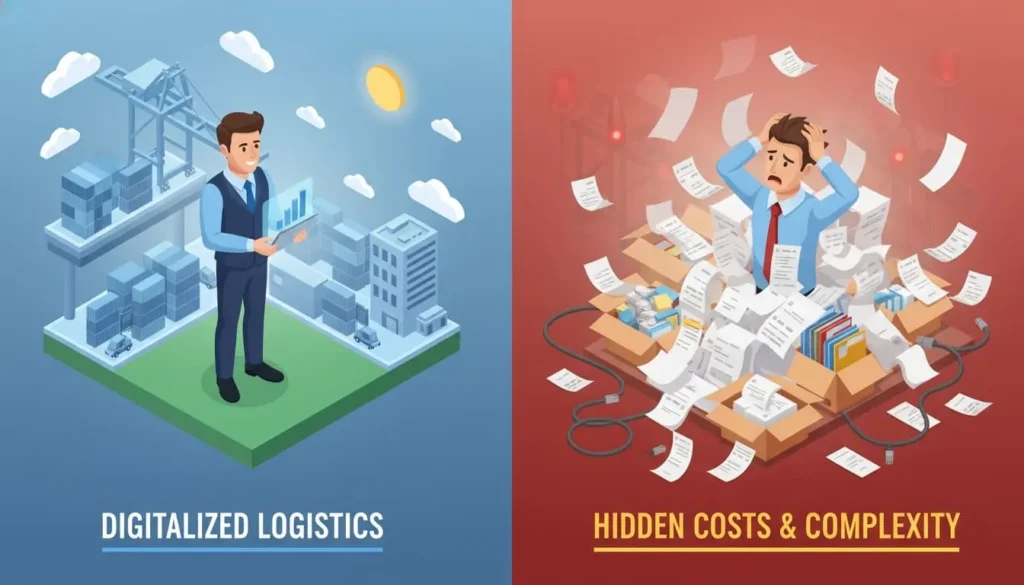
Master the entire supply chain: Shipping from China to Brazil 2026 Complete Guide
1. What Do FOB and CIF Actually Mean for Brazil Imports?
FOB (Free On Board): About 90% of Brazilian imports move this way. You hire the freight forwarder to book the vessel. The factory is only responsible for loading the goods onto the ship. After that, you call the shots.
CIF (Cost, Insurance, and Freight): About 10% use this (mostly beginners). The factory hires the forwarder and pays the freight, then includes the total price in your invoice. You only take over when the cargo arrives at the port.
How FOB Works
In FOB, you are the boss. You contact a freight forwarder (like us) to book the vessel. We report to you, not the factory. You know exactly what the sea freight costs, and you control the schedule.
How CIF Works
In CIF, the factory is the boss. They hire a forwarder who offers them the cheapest rate. The factory adds a markup to the shipping cost and bills you. When the cargo arrives in Brazil, you have to deal with the factory’s agent, who you don’t know and didn’t hire.
Comparison Table
| Feature | FOB (Recommended) | CIF (Risky) |
| Who pays Ocean Freight? | You pay the Forwarder directly. | Factory pays (and bills you later). |
| Who chooses the route? | You choose (fast vs. cheap). | Factory chooses (usually cheapest). |
| Who pays Insurance? | You buy it (cheap & easy). | Factory buys it. |
| Transfer of Risk | When cargo crosses the ship’s rail in China. | When cargo crosses the ship’s rail in China. |
| Cost Transparency | High (You negotiate the rates). | Low (Freight is built into product price). |
| Ideal for… | Importers who want control and lower costs. | Small shipments or beginners willing to pay more for “convenience”. |
Note: FOB vs. FCA? If your shipment is via Air Freight, the correct term is FCA (Free Carrier), not FOB. FOB is exclusively for sea/waterway transport.
2. Why is CIF Actually More Expensive?
You might assume CIF is just paying a small “service fee” for convenience.
Or, you might think: “The factory ships huge volumes, so they surely get better ‘bulk rates’ than I can.”
Think again.
Even if the factory gets a discount, do you really think they pass those savings to you? No. They keep the difference. The reality of CIF isn’t about convenience or discounts. It is a trap defined by three words: Expensive. Opaque. Mandatory.
Factory Markup on Freight
When a factory quotes you CIF, they don’t give you the shipping at cost. They add a margin. If sea freight is $2,000, they might charge you $2,300. You are paying a “convenience fee” without knowing it.
Inflating the Brazilian Tax Base
This is the biggest issue for Brazil. Brazilian import taxes (II, IPI, PIS, COFINS, ICMS) are calculated based on the Customs Value, which is the sum of:
Merchandise Value + International Freight + Insurance.
If the factory over-declares the freight by $300, you have to pay taxes on that extra $300.
Taxes are cumulative: An extra $300 in freight could turn into an extra $500–$800 in total tax costs. Good luck explaining to your accountant “why the freight on the invoice is so high.”

Destination charges: The “Surprise” Local Fees
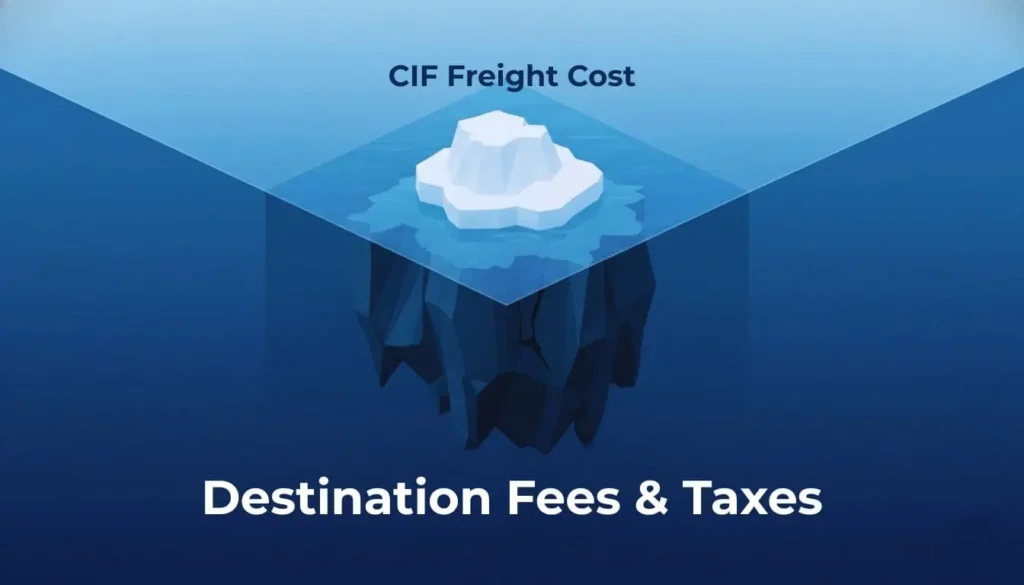
Under CIF, the Chinese supplier hires an agent there (usually the cheapest one). This agent needs to make a profit. Since they sold the freight very cheaply to the supplier, they charge abusive THC, Handling, and Deconsolidation Fees to you, in Brazil, to release the cargo.
This is the “hidden trap.” In CIF, the factory’s forwarder often gives the factory a super low sea freight rate (sometimes $0).
How do they make money? By charging you huge fees at the port of destination (Brazil). You might save $200 on shipping but get hit with a $1,000 “handling fee” when the ship arrives in Santos or Paranaguá. You cannot refuse to pay, or you don’t get your cargo.
Why this is worse than just paying more
- Opacity: You don’t know why you are paying so much, making it impossible to audit, reimburse, or explain to your boss.
- Lack of Control: The cargo is in their hands. You have no bargaining power. If you don’t pay, they don’t release the goods.
- Chain Reaction Risk: An inflated tax base could trigger a tax audit. The risk of fines and blacklisting falls entirely on you.
3. Real Example: A Shipment of $20,000 Machine Parts
Let’s look at the math for a shipment of machine parts.
- Goods Value (EXW): $20,000
- Real Market Sea Freight: $2,000
- Estimated Brazilian Tax Rate: ~40%
Plan A: You choose CIF
- Factory Quote: $22,500 (They marked up the freight by $500)
- Tax Base: $22,500
- Taxes (40%): $9,000
- Destination Local Charges: $1,000 (Mandatory fee from the factory’s agent)
- Total Landed Cost: $32,500
- Result: You pay higher taxes and unexpected local fees.
Plan B: You choose FOB
- Factory Quote: $20,000 for goods
- Freight: You pay $2,000 to your forwarder
- Tax Base: $22,000 ($20k goods + $2k freight)
- Taxes (40%): $8,800
- Destination Fees: Your agent charges standard fees, approx $200
- Total Landed Cost: $31,000
- Result: Lower tax base, transparent fees, no surprises.
FOB saves you money on the product, the tax, and the landing fees. That is a saving of about $1,500 (5%). This becomes even more significant when you scale up your operations.
4. Why Are Other Terms Not Recommended?
Beyond the classic FOB vs CIF , there are other options. Here is how they compare:
EXW vs. FOB vs. CIF
- EXW (Ex Works): The supplier leaves the cargo at their factory door. You must hire a truck in China and handle Chinese export customs clearance.
Avoid it. It is too much of a headache for a Brazilian importer to deal with Chinese customs remotely. You have to manage trucking and export customs clearance inside China.
Brazilian importers rarely use this, unless you have a trusted Chinese forwarder (like GWT). FOB is much safer as the supplier guarantees the cargo leaves China properly.
FOB vs. CIF vs. CFR (CNF)
- CFR (Cost and Freight): Formerly known as CNF or C&F. It is exactly the same as CIF, but without insurance.
It carries the same risks of hidden costs as CIF. But you must remember to buy your own insurance.
Without insurance, if the cargo is damaged or lost at sea, you lose 100% of your money because the seller has no obligation to pay you back, and you have no insurance policy to claim.
FOB vs. CIF vs. DDP
- DDP (Delivered Duty Paid): The “Dream Scenario”: the supplier delivers to your door in Brazil with all taxes paid.
Dangerous and Not Recommended for B2B. Due to Brazil’s RADAR laws, legal DDP is extremely rare. Most offers are actually “Gray Customs” schemes that risk immediate cargo seizure and blacklisting your CNPJ.
Operationally, DDP strips your control. As the importer of record, you remain liable for fines if the supplier misdeclares NCM codes to cut costs. With bundled pricing and a forwarder who works for the seller, you lose visibility on true costs and have no leverage to verify delays.
5. When Should You Use FOB and When Is CIF Acceptable?
Should you ever use CIF? Sometimes, but be careful.
Who should almost always choose FOB?
- Brazilian Factories/Retailers: If you import regularly, FOB is mandatory for cost control.
- Importers with a Despachante (Broker): Your broker prefers FOB because the documentation is clearer.
- Cost-Sensitive Buyers: If margins matter, FOB is the only choice.
When is CIF acceptable?
- Very small trials: If the total value is under $1,000 and it’s coming by courier (DHL/FedEx), CIF/DAP is fine.
- Total Beginners: If you have zero knowledge of logistics and just want to test one pallet, CIF is okay, just be prepared to pay extra.
Quick Self-Check List
- Do you have a trusted freight forwarder in China? Yes → Go FOB.
- Do you have a Customs Broker (Despachante) in Brazil? Yes → Go FOB.
- Is cost transparency important to you? Yes → Go FOB.
6. How to Switch from CIF to FOB in Practice (Step-by-Step)
Transitioning from CIF to FOB might seem intimidating if you are used to the supplier handling everything, but it is actually a standard procedure in international trade.
Here is a simple 5-step guide to help you:
Step 1: Renegotiate with Your Supplier
For your next Purchase Order (PO), inform your supplier that you are changing the shipping terms.
Step 2: Appoint a China-Side Forwarder
You need a representative in China to receive the cargo. You can find one through:
- A recommendation from your local Brazilian customs broker (Despachante).
- Your own research for a specialized China-Brazil freight forwarder (like GWT).
Step 3: Define Factory Responsibilities
Clarify to your factory that under FOB terms, their responsibility does not end at their factory door.
Step 4: Secure Transparent Rates
Before booking, agree on the freight rate with your new forwarder.
- Ensure the Ocean Freight and Origin Charges are clearly itemized.
This transparency is crucial for your accountant in Brazil to calculate the correct tax base (Tax Base) for II, IPI, and ICMS, avoiding the “double taxation” effect of CIF.
Step 5: Start from A Test
You don’t have to switch your entire supply chain overnight.
- Try the FOB model on a single LCL shipment or one 20ft container first.
- Check if the communication flows smoothly and if the arrival costs in Santos/Paranaguá are indeed lower.
- Once you validate that the process is smooth and the savings are real, move your regular monthly volumes to FOB.
Need help with Step 2? GWT can act as your appointed forwarder immediately. We coordinate directly with your supplier to ensure Step 3 and Step 4 are executed perfectly.
7. If You Are Stuck with CIF, What Can You Still Control?
In reality, many importers cannot switch from CIF immediately.
Factories insist on it, framework contracts are already signed, or management prefers to avoid changes.
If you are temporarily locked into CIF, you are not powerless. Here’s what you can still control during the transition:
1. Request the destination charges in advance
Before shipment, ask the supplier to provide:
- Their appointed China-side forwarder contact
- A written destination local charges list (THC, handling, deconsolidation, etc.)
2. Keep your own Despachante in charge of customs clearance
Even under CIF, you can (and should) use your own customs broker.
Make sure your Despachante reviews the Commercial Invoice, Packing List, and NCM codes before shipment to prevent customs issues and fines.
3. Use CIF as a short-term transition strategy
Use your next 1–2 CIF shipments to observe:
- Hidden costs
- Delays
- Agent performance
At the same time, start getting FOB quotes from China-side forwarders.
This gives you real data to negotiate and prepare for switching away from CIF.
8. How to Choose a China Freight Forwarder for FOB Shipments?
Deciding to switch from CIF to FOB is the strategic move. But to make it work, you need an operational partner who can actually execute it. A bad FOB forwarder can cause just as many headaches as a CIF supplier.
Look for these 4 points when choosing a forwarder (applies to any company):
- Real Presence: They must have a real operations team in China (not just a middleman passing orders).
- Direct Communication: They must be willing to talk directly to your Despachante regarding NCM codes and documentation.
- Visual Proof: They must provide loading supervision photos and cargo inspection photos.
- Transparent Quoting: The quote must be split clearly: Ocean Freight / Origin Charges / Other fees.
How GWT Helps: GWT specializes in handling FOB shipments for Brazilian clients. We act as your operations team in China.
- For Brazilian importers
We contact your suppliers directly. We arrange the pick-up, handle the China export customs clearance, and load the container. We double-check the documents so your Despachante doesn’t have issues in Brazil.
- For Brazilian forwarders
If you are a logistics company in Brazil, we are your “boots on the ground.” We handle the local operations (warehousing, trucking, customs) neutrally and professionally.

Typical FOB Workflow with Us
- Typical FOB Workflow with Us
- Booking: You authorize us to contact your factory.
- Coordination: We verify the cargo readiness date.
- Loading: Factory delivers the goods → We inspect and take photos → Container loading.
- Documents: We send the draft Bill of Lading (BL) for your approval before the ship sails.
- Departure: Ship sails → Original documents are sent to Brazil.
FOB gives you control. CIF gives the factory control. For shipping to Brazil, control means saving money.
FAQ
What is the main difference between FOB and CIF for shipping from China to Brazil?
FOB (Free On Board) means you control the freight and choose the forwarder. The supplier is only responsible until the goods are on the ship in China.
CIF (Cost, Insurance, and Freight) means the factory handles the freight and adds the cost to your invoice.
Key difference: FOB gives you cost transparency and control over the schedule. CIF hides the true freight cost and often leads to higher taxes and hidden destination fees in Brazil.
Why do you say CIF causes “higher taxes” in Brazil?
In Brazil, import taxes (II, IPI, PIS, COFINS, ICMS) are calculated based on the Customs Value, which includes the Freight cost.
In CIF, factories often mark up the freight cost (e.g., real cost $2,000 → invoiced cost $2,500).
Because taxes in Brazil are cumulative, that extra $500 in freight can result in $800+ in extra taxes that you didn’t need to pay. With FOB, you declare the real market freight rate.
Why are the destination charges (Local Fees) at Santos so high with CIF?
This is the “hidden trap” of CIF. The Chinese supplier often pays very little (or zero) for the sea freight to their agent.
To make a profit, the agent’s partner in Brazil charges you (the importer) inflated fees for THC, Handling, and Deconsolidation.
You have no bargaining power because the cargo is in their hands.
With FOB, you negotiate these local fees before the ship leaves China.
Is DDP (Delivered Duty Paid) safe for B2B imports to Brazil?
No. In the China–Brazil trade lane, a significant number of low-priced DDP solutions rely on gray customs arrangements, such as under-invoicing or routing cargo through third countries.
Using these structures exposes your company to serious compliance risks. Cargo may be seized by the Brazilian Federal Revenue (Receita Federal), and your CNPJ can be flagged or restricted, affecting future imports.
DDP itself is not illegal. However, in high-tax and highly competitive markets like Brazil, many low-cost DDP offers only work by bypassing proper customs valuation and tax payment.
For B2B importers seeking long-term stability and legal security, the safest approach is to remain fully compliant
This typically means using FOB or CIF terms, appointing your own freight forwarder, and paying import duties and taxes directly under your company’s name.
What about CFR (or CNF)? Is it better than CIF?
No, it can be worse.
CFR is exactly like CIF, but without insurance.
The seller still controls the ship (often choosing the cheapest/worst carrier), but you bear the risk of loss or damage once the cargo leaves the factory.
If you forget to buy insurance and the ship sinks or cargo is damaged, you lose 100% of your money with no recourse.
Can I use FOB for Air Freight shipments?
Technically, no. “FOB” is a maritime term. For air shipments (like courier or air cargo), the correct term is FCA (Free Carrier).
However, the logic is the same: You hire the forwarder, and you control the freight. Just make sure to write “FCA [Airport Name]” on your Purchase Order instead of FOB to be legally accurate.
I am a beginner. Can I use FOB if I don’t know any forwarders in China?
Yes. In fact, it is safer for beginners to start right.
You don’t need to know “many” forwarders; you just need one reliable partner (like GWT).
We act as your operations team in China, talking to your factory and handling the export customs. You can start with a single small shipment (LCL) to test the process before moving your main volume.
If I am already stuck with a CIF shipment, what can I do to avoid surprises?
Damage control is key. Before the ship arrives:
1. Ask the supplier for the Destination Agent’s contact details.
2. Demand a written list of Local Charges (THC, handling, etc.) immediately.
3. Ensure your own Despachante handles the customs clearance, not the agent provided by the supplier. Treat this shipment as a lesson, and use the cost data to negotiate FOB terms for your next order.