By GWT Team / Updated: Feb 21, 2026 / 6 min read
Transporting an excavator, a heavy-duty crane, a CNC machine, or other industrial equipment from China to Brazil is not standard “international shipping.” It is oversized cargo logistics. You are not just putting a box on a ship; you are coordinating heavy lifting, port engineering, and complex international trade laws.
The biggest challenges you face are:
- Excessive dimensions: Equipment that is too wide, too tall, or too long for standard shipping containers.
- Extreme weight: Machinery that exceeds standard crane capacities or road weight limits.
- Port handling limitations: Not every port has the equipment to lift a 40-ton machine.
- Complex Brazilian import regulations: Brazil’s customs authority is notoriously strict, especially regarding taxes and used machinery.
In this guide, you will learn exactly how this process works. We will cover which transport method is best for your specific equipment, how much it realistically costs, and how long the door-to-door timeline takes. We will also break down how to handle Brazil’s customs requirements, including NCM codes, RADAR registration, and the strict rules for importing used machinery.
By the end of this article, you will know how to evaluate your project’s feasibility, estimate your budget, and prepare the exact information you need before contacting a freight forwarder.
3 Ways for Oversized Equipment Transport China Brazil
Standard 20-foot or 40-foot closed containers are usually impossible for heavy machinery. You cannot physically fit a large wheel loader through the doors. Here are the three main solutions used in oversized equipment transport China Brazil.
Special Containers (Special Container Shipping Machinery Brazil)
When cargo does not fit in a standard box but can still be placed within the container stacking system of a cargo ship, we use special containers. This is a core part of special container shipping machinery Brazil.
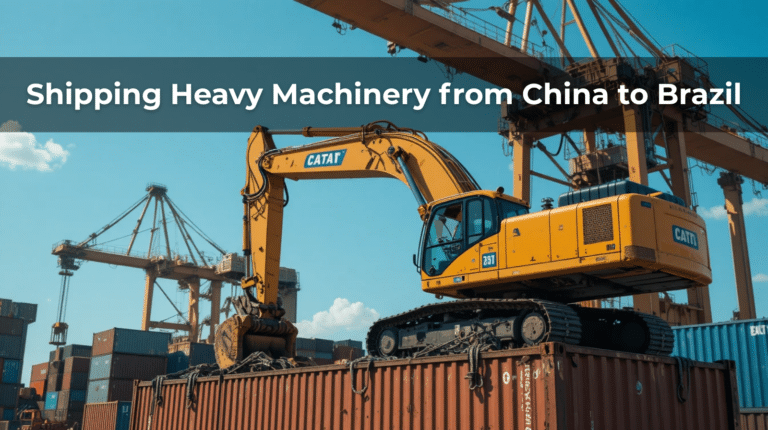
1) Flat Rack Containers
A Flat Rack is exactly what it sounds like: a heavy-duty steel base with no side walls and no roof. It only has collapsible end walls.
- Best for: Over-width or over-height machinery. Equipment that is simply too awkward to load through a container door, such as large tractors, industrial generators, or mining units.
- Advantages: You can load the machinery directly onto the base using a crane from the top or a heavy forklift from the side. Flat racks fit into the standard slots on a container ship, making them widely available on major routes like China to Brazil.
- Cost level: Higher than standard containers. If your cargo is wider or taller than the flat rack base, it will block the container spaces next to it or above it. You have to pay the shipping line for those “lost slots.”
- Operational notes: Your machinery must have designated, heavy-duty lifting points. The lashing and securing process must be certified by the port before the ship will load it.
2) Open Top Containers
An Open Top container has four solid steel walls and doors, but the solid steel roof is removed and replaced with a heavy-duty tarpaulin.
- Best for: Over-height machinery that has normal length and width.
- Advantages: You can drop the machinery in directly from the top using a crane. The tarpaulin covers the equipment, offering better weather protection than a Flat Rack.
- Cost level: Slightly higher than a standard container, but generally more economical than a Flat Rack because the cargo does not hang over the sides, meaning you avoid “lost slot” width penalties.
Ro-Ro Vessels (Roll-on/Roll-off)
Ro-Ro ships are basically massive floating parking garages. Cargo is not lifted by cranes; it is driven onto the ship.
- Best for: Self-propelled or towable equipment. This includes excavators, dump trucks, agricultural tractors, and mobile cranes.
- Advantages: The machinery is driven directly up a ramp and into the vessel. It is parked on enclosed decks, completely protected from saltwater and weather. Ro-Ro is often more economical than using a Flat Rack because you do not have to pay for heavy port cranes or extensive container lashing materials.
- Limitations: The equipment must be capable of rolling. If it breaks down at the port, it cannot be loaded. Ro-Ro ships have a limited sailing frequency compared to standard container ships, and they only call at specific Ro-Ro compatible ports.
Breakbulk (Conventional Vessel)
Breakbulk involves loading oversized cargo directly into the hold or onto the deck of a conventional cargo ship, completely free of any container structure.
- Best for: Extremely large equipment. Complete factory production lines, massive bridge girders, or transformers that weigh 80 tons.
- Advantages: There is absolutely no container size limitation. If the ship has deck space, it can take it. It is the only option for ultra-heavy pieces.
- Cost level: Usually carries a much higher port handling cost. Freight is charged based on RT (Revenue Ton), which compares the metric weight against the volumetric size and charges you whichever is higher.
- Operational requirements: Requires heavy-duty port cranes (often tandem lifts using two cranes at once) and highly specialized coordination between the trucking company, the port terminal, and the ship’s captain.
Heavy Machinery Freight Cost China Brazil: What to Expect
Budgeting for machinery is complex. You cannot just look up a standard rate online. Here is a breakdown of heavy machinery freight cost China Brazil.
How Pricing Actually Works
Heavy lift cargo is not priced on a “one container = one fixed rate” basis. For Out of Gauge (OOG) and breakbulk cargo, pricing depends on a few specific metrics:
- Weight (Metric Tons): The physical mass of the cargo. Heavy cargo limits how much other cargo the ship can take.
- Volume (CBM): The cubic meters of space the machine occupies.
- Revenue Ton (RT) calculation: Shipping lines charge by weight or volume, whichever yields higher revenue. Typically, 1 metric ton equals 1 CBM. If your machine weighs 20 tons but takes up 40 CBM of space, you will be billed for 40 Revenue Tons.
- Lost slot impact: As mentioned earlier with Flat Racks. If your over-width tractor blocks three container spaces on the ship, you pay for all three spaces.
- Port handling complexity: Lifting a 40-ton machine requires specific cranes, specialized rigging crews, and extra time, all of which you pay for.
Example Budget Ranges (Reference Only)
While final pricing depends entirely on your exact specifications, here are typical market ranges based on 2024–2026 data:
- Mid-sized excavator (20–25 tons) via Flat Rack: Approximately USD 15,000 – 35,000 port-to-port. The massive variance depends on the width of the tracks and the resulting lost slot fees.
- Same unit via Ro-Ro (if self-propelled): Often 10–20% lower than the Flat Rack option, as it avoids crane and lashing surcharges.
- Large industrial unit via Breakbulk: USD 30,000 and up, scaling rapidly depending on the RT calculation and the specific heavy-lifting requirements at the origin and destination ports.
Note: These figures fluctuate heavily based on the season, global fuel surcharges (BAF), and which specific ports you select.
Cost Breakdown
When you receive a quote, ensure it details the following line items. Do not accept a single lump-sum number without a breakdown:
- Ocean freight: The actual cost of the voyage.
- Port handling (THC): Terminal Handling Charges at both the Chinese and Brazilian ports.
- Crane surcharge: Fees for heavy-lift equipment.
- Lashing & securing: Chains, turnbuckles, dunnage wood, and the labor to secure the machine.
- Customs clearance (Brazil): Broker fees.
- Import tax & duties: Brazilian federal and state taxes.
- Inland trucking: Moving the machine from the factory to the Chinese port, and from the Brazilian port to the final job site using heavy-haul trailers.
DDP vs DDU – Who Pays Brazil Taxes?
Brazil has a notoriously high and layered import tax structure (II, IPI, PIS, COFINS, ICMS).
- DDP (Delivered Duty Paid): The seller or freight forwarder handles all transport, customs, and taxes. The buyer in Brazil simply receives the cargo. This is extremely difficult to execute in Brazil without a highly reliable local importing partner who acts as the Importer of Record.
- FOB/CIF + DDU: The buyer in Brazil takes over responsibility once the goods arrive. The buyer must have active RADAR registration, hire their own broker, and pay the taxes directly to the Brazilian government.
Always clarify exactly who is responsible for customs and taxes before the ship leaves China. Misunderstandings here result in abandoned cargo.
Machinery Shipping Time to Santos and Other Major Ports
Transit time is not just the days spent on the water. Here is a realistic look at machinery shipping time to Santos and the total project timeline.
Main Departure Ports in China
You cannot ship a 50-ton machine from just any local river port. You need major hubs with strong crane and OOG handling capacity:
- Shanghai
- Tianjin
- Qingdao
- Guangzhou
Main Arrival Ports in Brazil
- Santos: The largest port in Latin America. It has the most equipment, the most frequent vessel calls from China, and the deepest experience in handling heavy machinery.
- Vitoria: A common alternative port specifically designed for bulk and project cargo, often used for large industrial or mining equipment heading to the southeastern states.
Transit Time (Port-to-Port)
- To Santos: Expect 35–45 days by sea for containerized or breakbulk vessels.
- Ro-Ro and breakbulk sailings are much less frequent than standard container vessels. You cannot just book a ship leaving tomorrow.
- Booking oversized cargo usually requires 3–4 weeks of advance planning to secure space and get the technical load plans approved by the ship’s captain.
Total Timeline (Door-to-Port Estimate)
Do not plan your project based on the 40-day sailing time. Use this realistic full-cycle timeline:
- 1–2 weeks: Booking space, arranging heavy trucking to the Chinese port, and export preparation.
- 35–45 days: Ocean transit across the Pacific and Atlantic.
- 1–3 weeks: Brazil customs clearance. This depends heavily on whether your documentation is perfect and if you need special import licenses (LI).
Total realistic planning window: Expect 8 to 12 weeks from the moment the truck picks up the machine at the Chinese factory to the moment it is released from the Brazilian port.
Practical Guide: Securing, Rust Prevention & Brazil Customs
Getting the machine on the ship is the physical challenge. Making sure it survives the trip and clears the paperwork is the administrative challenge.
Lashing & Protection
Improper securing will cause catastrophic damage. If a 20-ton machine breaks loose in a storm, it will destroy the ship’s deck and other cargo.
- Certified lashing plan: The cargo must be secured using heavy-duty steel chains, tensioning devices, and wooden blocking and bracing bolted to the deck. A surveyor must certify the lashing before departure.
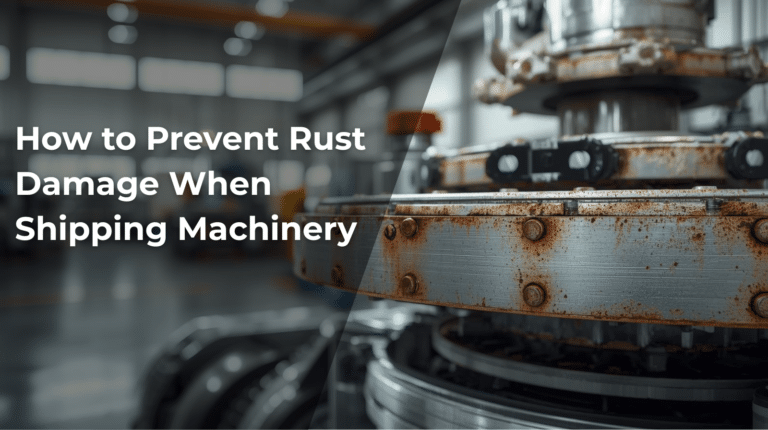
- Anti-corrosion oil and VCI: The China–Brazil route crosses the equator. The machine will be exposed to extreme heat, cold nights, humidity, and high-salinity sea air. If the metal is unprotected, it will arrive covered in rust. You must coat exposed hydraulic cylinders and machined parts with anti-corrosion oil and use VCI (Vapor Phase Corrosion Inhibitor) packaging for sensitive electronics.
Brazil Customs & Documentation
Brazil import compliance is the most complex part of this entire process. Do not treat the paperwork lightly.
1) NCM Code Accuracy
The NCM code (Mercosur Common Nomenclature) dictates your tax rate and regulatory requirements.
- Incorrect classification leads to applying the wrong tax rate.
- If Brazilian customs catches an error, they will issue massive fines and delay your cargo indefinitely.
- Always have a Brazilian customs broker confirm the exact NCM code before you issue the final Commercial Invoice in China.
2) RADAR Registration
The Brazilian importing company must have a valid RADAR authorization to access the Siscomex system.
- Without an active RADAR license, a company cannot legally import anything under its own name.
- If the buyer does not have RADAR, they must hire a licensed local trading company to import the machinery on their behalf.
3) Used Machinery Restrictions
Brazil actively protects its domestic manufacturing industry. Importing used machinery is highly restricted.
- Used heavy equipment usually requires an explicit Import License (LI) before the cargo boards the ship in China.
- It requires technical approval to prove that similar equipment is not manufactured locally in Brazil.
- This approval process involves the DECEX department and can take weeks or months. Never ship a used machine to Brazil without confirming the LI is approved.
Information You Must Prepare Before Contacting a Forwarder
To get an accurate quote and avoid delays, gather this exact data before you ask a forwarder for pricing:
- Exact dimensions: Length × Width × Height (in meters or millimeters). Do not guess.
- Gross weight: In metric tons.
- Photos: Clear pictures of the machine, preferably showing the lifting points.
- Lifting points: A technical drawing showing where the crane hooks should attach and the center of gravity.
- Mobility: Is the equipment self-propelled, towable, or completely static?
- Port of destination: Santos, Vitoria, etc.
- Trade terms: FOB, CIF, or DDP? Who is paying for what?
- Status: Is the machine brand new from the factory, or is it used?
Providing this data upfront prevents inaccurate pricing, rejected bookings, and logistical disasters at the port.
Why You Need an OOG / Heavy Lift Freight Forwarder
Heavy machinery shipping is not standard freight. A company that ships plastic toys in standard containers does not know how to calculate heavy-lift crane stress or navigate Brazilian used-machinery import licenses.
You need a professional OOG (Out of Gauge) and heavy lift forwarder. They will:
- Review your exact dimensions and suggest the optimal loading method (saving you from paying for a Flat Rack if Ro-Ro is viable).
- Calculate the exact lost slot and RT (Revenue Ton) impact early, so your budget is accurate.
- Control and negotiate the crane, lashing, and port handling costs on your behalf.
- Coordinate directly with your Brazilian customs broker to ensure tax estimations and NCM codes align.
- Arrange the specialized inland heavy-haul trucking from Santos to the final construction site.
Working with an expert reduces physical risk, eliminates cost surprises, and ensures your cargo actually clears Brazilian customs.
FAQ
Should I choose Flat Rack or Ro-Ro for my 20-ton excavator?
If the machine is in working order (self-propelled) and the departure/arrival ports support Ro-Ro vessels, Ro-Ro is often the more economical and safer choice. If the machine cannot roll, or if the sailing schedule for Ro-Ro is too slow for your project, a Flat Rack is your best alternative.
Can used machinery be imported into Brazil?
Yes, but it is heavily regulated. It requires a prior Import License (LI) approval from the Brazilian government, highly accurate NCM classification, and strict documentation proving the machine’s value and technical specs. The approval process can take weeks, so start early.
How is special container freight calculated?
Freight rates for special containers and breakbulk are not flat fees. They are based on the weight of the cargo, the volume (CBM), the Revenue Ton (RT) calculation, the cost of “lost slots” (if the cargo overhangs and blocks other containers), and the complexity of the port handling (crane requirements). You must provide full specs to get an accurate number.